 All articles
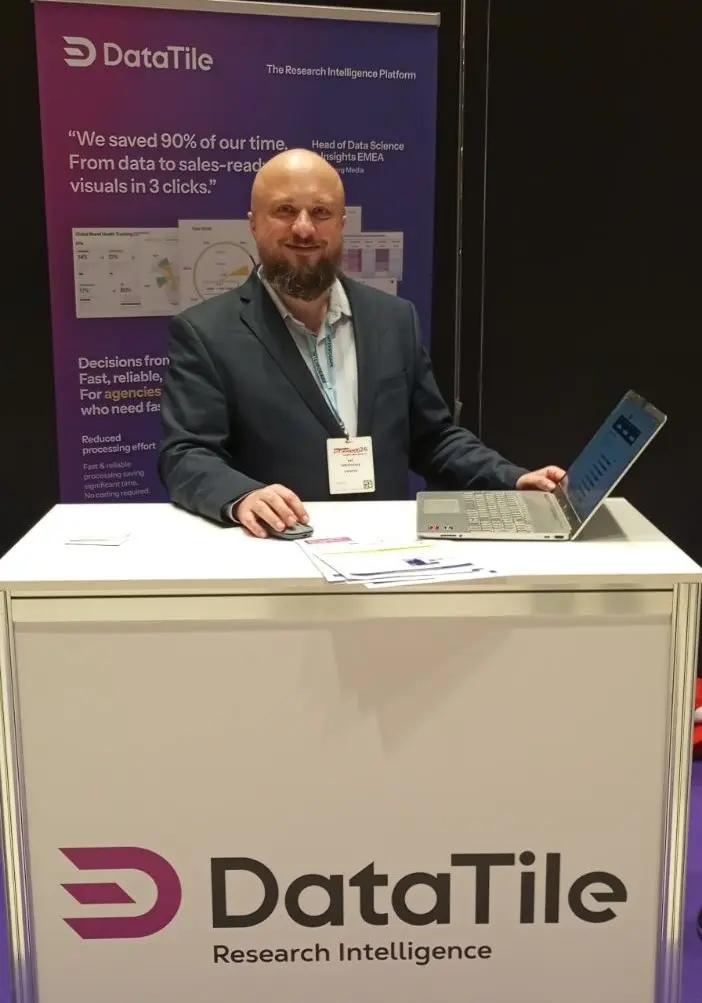
After two days at the booth and around thirty demos, one thing became clear very quickly: the same workflow frictions kept coming up across research teams in different businesses and countries.
succeet26 turned out to be the largest research event in this experience so far, but the problems discussed are all the same again and again.
The audience was mostly relevant, in a very German and practical sense of the word. Some meetings were scheduled in advance, others followed the CEO’s talk.
What everyone needs
Conversations were consistently concrete; both research agencies and brand owners had a clear idea of what they wanted to see in a tool as a must, and what could be a pleasant extra. What was repeated was not a single shared task, but two separate lines of demand.
On one side, there is a need for a simple, flexible, and transparent way to analyze data without relying on rigid tools.
On the other hand, control: access management; privacy; a clear understanding of how AI interacts with data, and the ability to strictly control that interaction; and visibility into how the product is used within a team.
Why routine research work still feels harder than it should
At the same time, the baseline is technically covered, but often in ways that feel limiting. Some teams rely on BI tools not designed for survey data, while others remain on legacy solutions because switching is perceived as more costly than continuing to live with outdated and inconvenient tools. In both cases, the setup works, but not without friction.
Against this backdrop, it was noticeable how often everyday functionality came up in conversations. The need for:
- automatic trend updates,
- working with weighted and unweighted data,
- flexible cross-tabulation,
- setting up and comparing target audiences quickly,
- exporting results in a format people can actually use.
These are not edge cases, but regular tasks that still feel unnecessarily difficult in day-to-day work.
If that sounds familiar in your team, we’d be genuinely interested to compare notes and discuss it in comments or messages. A lot of the most useful conversations at succeet26 started exactly there: with practical frustrations that many teams quietly accept as normal.
A good news: we already have those features or are working on them!
A more telling signal was how often requests matched things already in development.
At one point, someone asked about a feature that was literally being in development during the succeet26. Saying “The release will happen next week” sounded more surprising than the feature itself.
For me, that was one of the clearest signs from the event: how much of the current direction has already been shaped by work with clients. More and more often, conversations shifted from “this aligns with our development strategy” to “this is how we already do it”.
AI mattered, but not in the way people often assume
AI is clearly part of the picture and often comes up in discussions. At the same time, it does not act as a universal solution or a single deciding factor. It sits alongside more fundamental expectations around reliability, transparency, and control.
People were interested, but they also wanted clarity. What is automated, what is deterministic, what can be checked, and what remains under human control? Those questions felt more important than AI for AI’s sake.
What feels clearer after succeet26
The context is changing. The current set of tools no longer feels sufficient. People expect more flexibility, faster workflows, and the ability to run analysis on their own, while still keeping control over access and usage. And beauty! Many dashboards still inherit patterns from finance or logistics BI teams, which are used for monitoring rather than exploration, making them less suited to research workflows and sometimes quite boring.